
Speaking
Part 3 Answer Builder
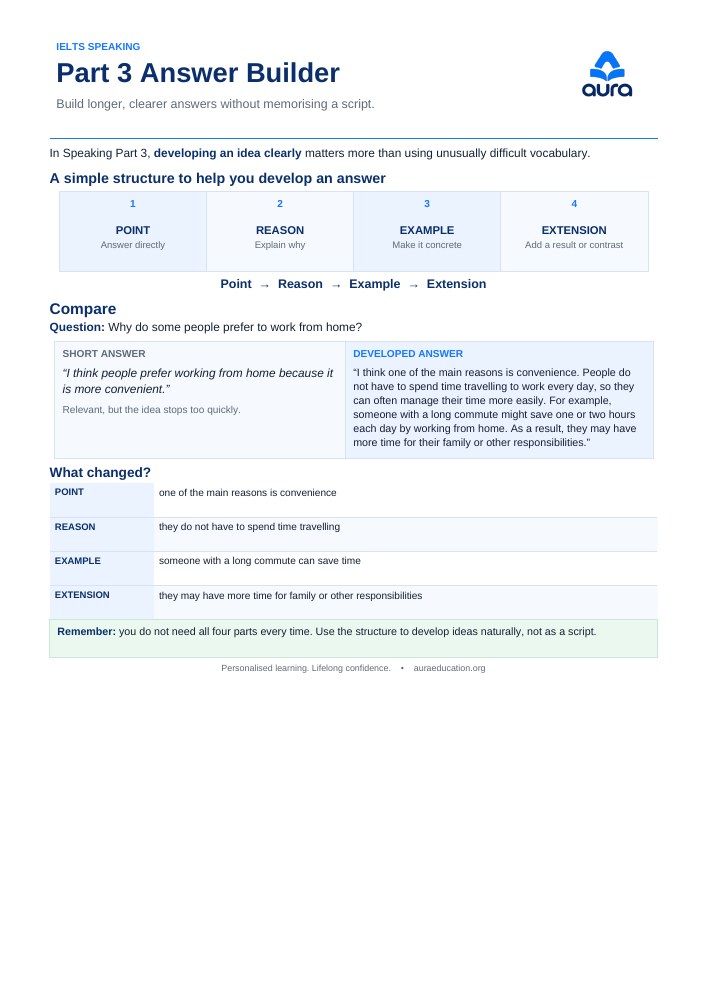
Build longer, clearer Part 3 answers without memorising a script.
Download free resource →Practical topic guides, skill strategies and exam-style prompts to help you prepare with greater clarity.
A growing collection of free Aura tools designed to turn practice into clearer evidence and useful next steps.
Build longer, clearer Part 3 answers without memorising a script.
Download free resource →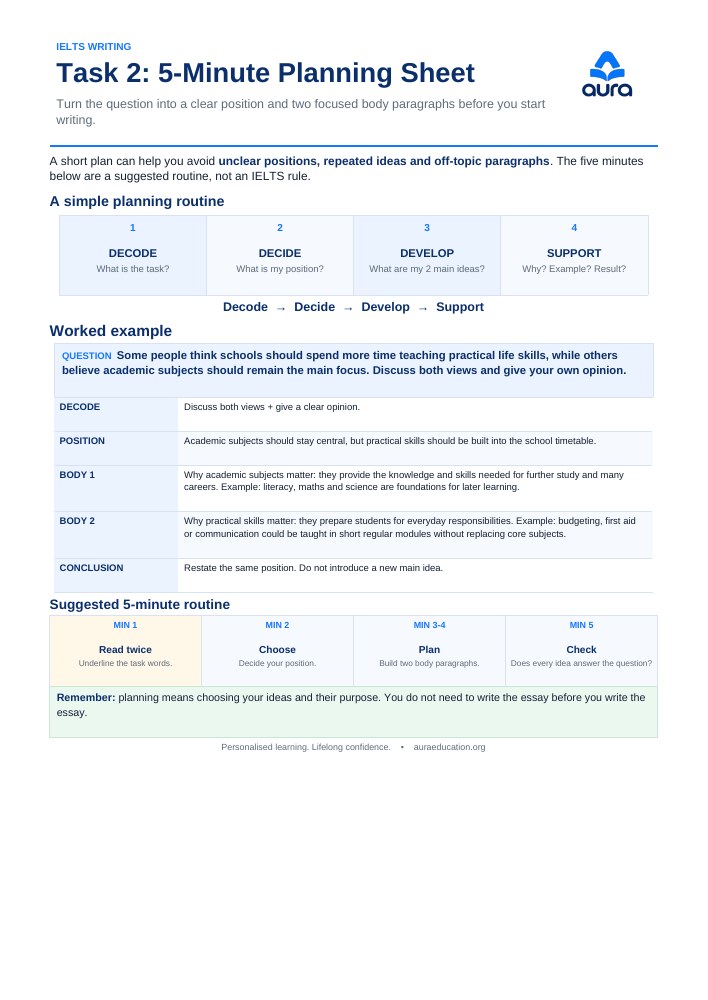
A simple planner to help you organise your ideas and write with confidence.
Download free resource →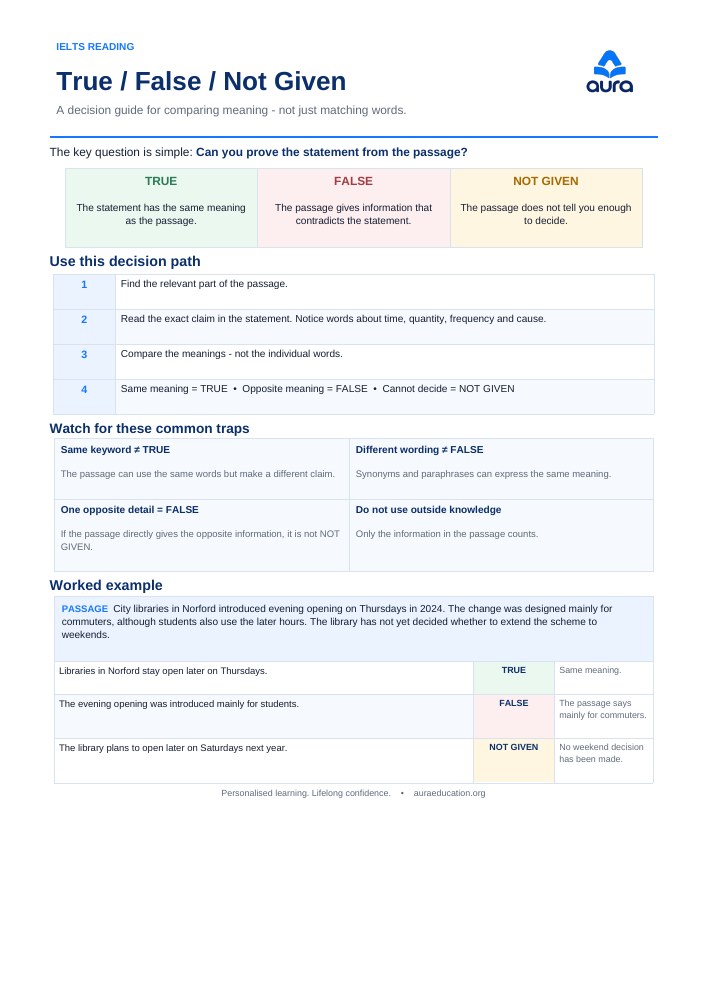
A clear, step-by-step guide to help you answer with accuracy.
Download free resource →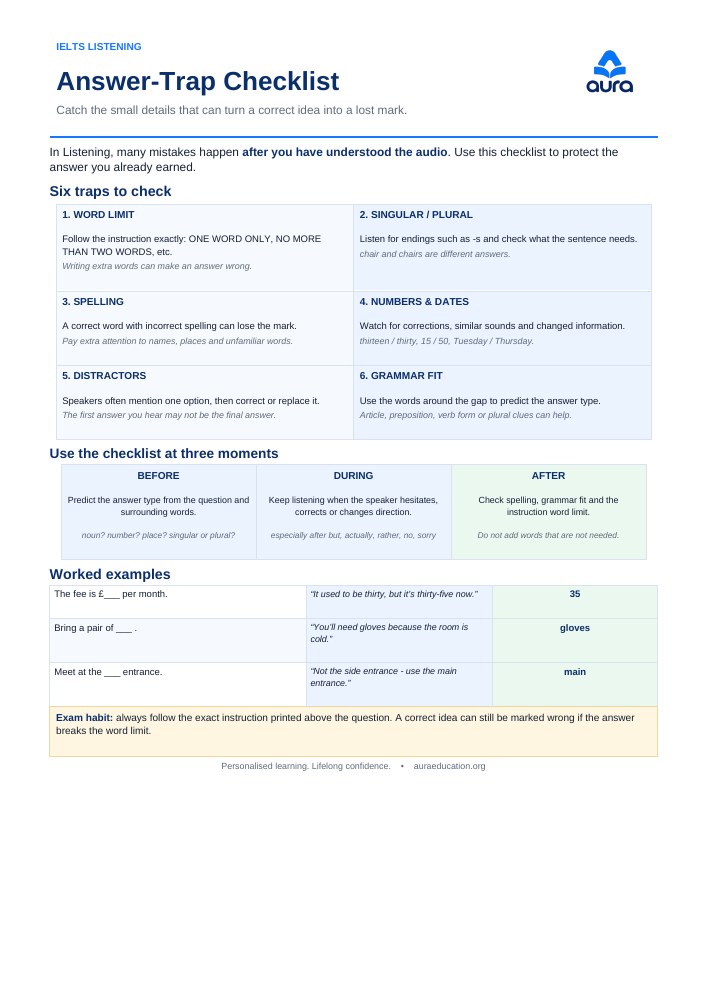
Spot common traps and avoid losing easy marks.
Download free resource →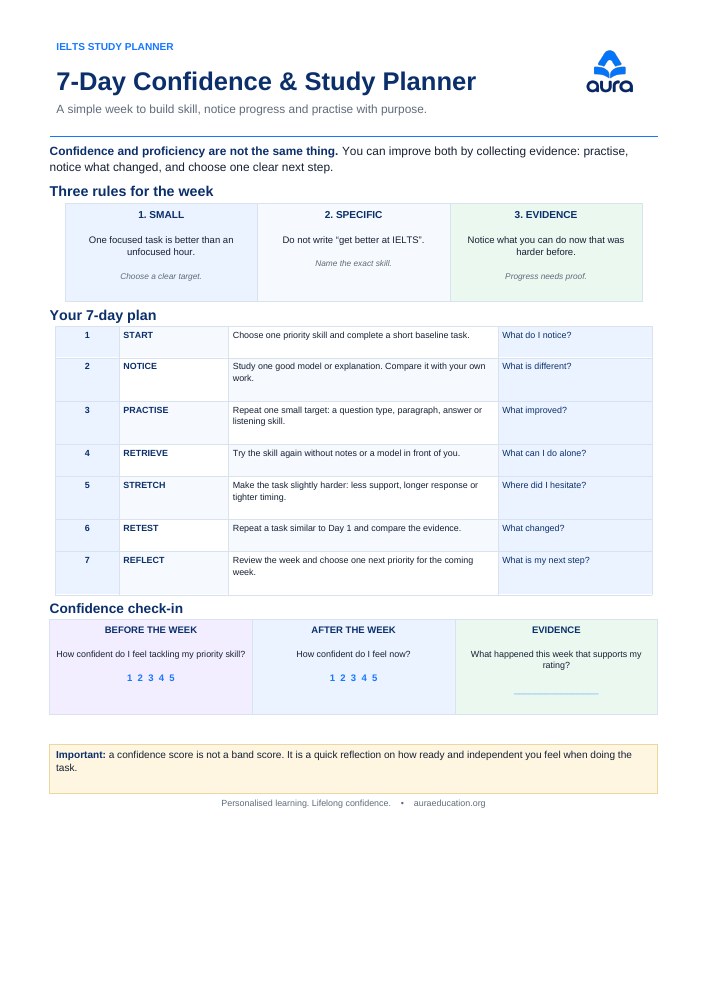
A simple 7-day planner to help you build good habits and steady progress.
Download free resource →Understand what each skill demands, where learners commonly lose marks and how Aura turns evidence into a useful next step.
Develop relevant, connected answers with fluency and confidence.
Read the guide →Build clear arguments, logical paragraphs and accurate language.
Read the guide →Locate evidence, understand question types and review errors.
Read the guide →Anticipate answers, follow meaning and recognise distractors.
Read the guide →Open any guide for useful language, a natural expression and an exam-style task. The aim is not memorisation—it is flexible, accurate communication.
Useful for discussing funding, access, teaching methods and the purpose of education.
pedagogy · rote learning · tertiary education · curriculum · extracurricular
Pass with flying colours — pass very successfully. Learn the ropes — learn how a task or role works.
Describe a subject you enjoyed studying at school. Say what it was, how you were taught, who taught you and why you enjoyed it.
Try this: Explain one feature of the teaching and connect it to its effect on your learning.
Move beyond general claims by naming causes, consequences and realistic responses.
sustainable · carbon footprint · biodegradable · deforestation · ecosystem
A drop in the ocean — an amount too small to have much effect. The tip of the iceberg — the visible part of a much larger problem.
Some people think environmental problems are too large for individuals to solve. To what extent do you agree or disagree?
Try this: Separate individual action from government and corporate responsibility before forming your position.
A broad theme covering workplace change, motivation, pay and work–life balance.
remuneration · job satisfaction · career progression · redundancy · flexible working
Climb the corporate ladder — advance through an organisation. Burn the midnight oil — work or study late at night.
How has the workplace changed in your country over the past 20 years? Could a four-day week become normal?
Try this: Compare one past feature with the present, then explain what caused the change.
Explore personal journeys alongside tourism’s economic, environmental and cultural effects.
itinerary · ecotourism · commercialised · pristine · cultural heritage
Off the beaten track — away from popular places. Catch the travel bug — develop a strong desire to travel.
Describe a memorable journey. Say where you went, how you travelled, why you went and what made it memorable.
Try this: Organise the story around a turning point or vivid moment instead of listing events.
Discuss AI, communication, access, privacy and the changing role of technology.
automation · cybersecurity · digital literacy · obsolete · virtual interaction
Cutting-edge — highly advanced or innovative. Not rocket science — not especially difficult to understand.
Technology makes communication easier but may also increase isolation. Discuss both views and give your opinion.
Try this: Define what “isolation” means before evaluating whether technology causes it.
Common questions examine diet, inactivity, prevention and public responsibility.
sedentary lifestyle · preventive medicine · detrimental · public-health campaign · holistic
Under the weather — feeling slightly unwell. Fit as a fiddle — in very good physical health.
Should governments heavily tax unhealthy foods? How can schools encourage children to be more active?
Try this: Consider effectiveness, fairness and unintended consequences when evaluating a policy.
Useful for housing, transport, migration, public space and infrastructure.
infrastructure · cosmopolitan · gentrification · urban sprawl · overpopulation
Concrete jungle — a densely built city with little green space. Hustle and bustle — busy, noisy urban activity.
More people are moving to cities, but urban life can be difficult. What are the main problems and how can they be solved?
Try this: Match every proposed solution directly to a problem you have already explained.
Use measured, objective language to discuss prevention, sentencing and rehabilitation.
deterrent · juvenile delinquency · rehabilitation · petty crime · reoffend
Caught red-handed — caught while committing an offence. Turn a blind eye — deliberately ignore wrongdoing.
Some believe longer prison sentences are the best way to reduce crime; others prefer alternatives. Discuss both views.
Try this: Evaluate each approach against the same criteria: deterrence, public safety and reoffending.
Discuss influence, credibility, consumer behaviour and the circulation of information.
sensationalism · impartial · manipulated · target audience · censorship
Take it with a pinch of salt — treat a claim with scepticism. Hot off the press — newly published or announced.
Describe an advertisement you remember well. Say where you saw it, what it promoted, what happened and why you remember it.
Try this: Explain the technique that made the advertisement memorable, not only its content.
Explore globalisation, language, identity and changes in social practices.
assimilation · indigenous · folklore · cultural preservation · global village
Culture shock — confusion when encountering an unfamiliar culture. A melting pot — a place where cultures and ideas mix.
Traditional customs are being lost as people adopt modern lifestyles. Is this a positive or negative development?
Try this: Distinguish traditions that carry social value from practices that may reasonably evolve.
Reading a list creates recognition. Retrieval and application create learning.
Aura helps you focus practice where it can create the most value.